Next in our ongoing series of Morris finalist interviews, John Corey Whaley talks to Len Vlahos about his debut novel, The Scar Boys. Go forth, ye admirers of awesome, and check it out!
Author: rachelhartman
The Strange and Beautiful Sorrows of Ava Lavender
And here we are with Morris interview #2 already! Elizabeth C Bunce interviews nominee Leslye Walton about her debut, The Strange and Beautiful Sorrows of Ava Lavender. Another one for your ever-growing to-read list. Congrats to Leslye!
It’s Appreciate a Dragon Day!
So I’ve been thinking how best to appreciate dragons today. If I were any kind of baker, I’d have made a cake, but since I’m a writer, I fear you’re going to have to settle for words. They’re less fattening, certainly, but maybe not quite as tasty.
Over at Suvudu, they’re celebrating by excerpting the first chapter of Shadow Scale. I know some of you are being patient and won’t go for that, since it will just leave you hungry for more (hm! Maybe words are tastier than I give them credit for). Your patience will soon be rewarded: less than two months to go. Still, even if you don’t care to read the excerpt, go give Suvudu a hug for me. I’m so grateful for their support and enthusiasm.
You can find lots of excellent pictures of dragons on Twitter by following #AppreciateADragonDay. The medieval manuscript art is my favourite, but there are also Komodo dragons, Smaug, Toothless, something for everyone. The good folks at Random House have also compiled a “Seraphina Playlist” of recent tunes:
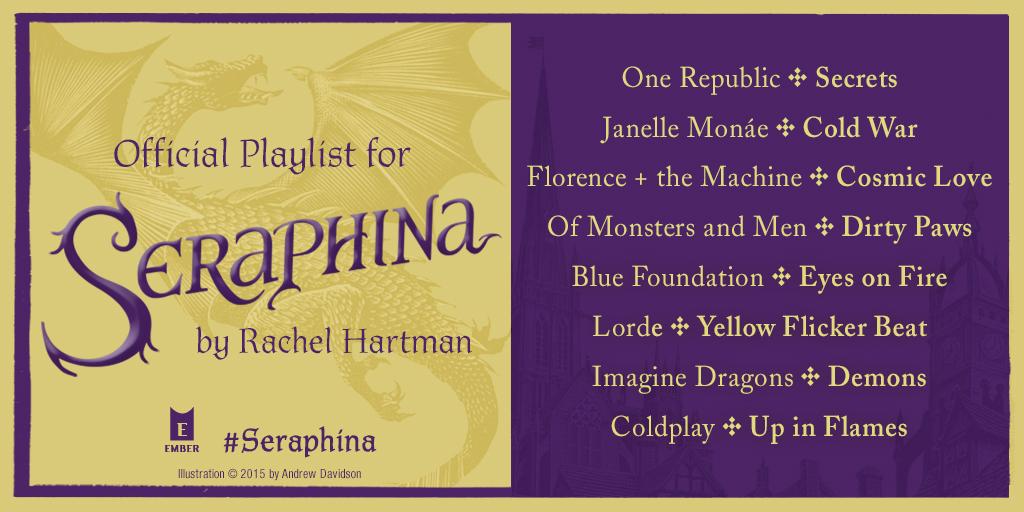
(NB: “Cold War” was my suggestion; the rest were suggested by people more knowledgeable of recent music than I am. There will also be a playlist of songs I actually listened to while working.)
Updated to add: Here’s my playlist! It’s a more eccentric mixture, I’ll grant you that.

For my own part, I’m going to answer the question posed by my husband last night: Why dragons?
It’s a good question, and one that’s actually kind of difficult for me to answer because I started loving dragons when I was quite young, before I was able to articulate any kind of reason beyond the fact that they were powerful and super cool. Other supernatural creatures couldn’t compare, in fact I don’t think there’s a one that holds my interest like a dragon.
My earliest exposure to dragons — besides Andrew Lang’s fairy books, which surely had dragons in them, but I don’t remember the specifics — must have been C. S. Lewis’s Voyage of the Dawn Treader, which I read at about age seven. Eustace Clarence Scrubb is turned into a dragon by his greed, and then in the book’s most vivid and memorable scene (to young me, anyway), Aslan peels off Eustace’s dragon skin and turns him human again. It’s a striking image and it underscores an important point about dragons: as much as we might wish to deny it, they’re a reflection of ourselves.
I think dragons combine two warring parts of our nature, the contradiction inherent in all of us, that we may be simultaneously monstrous and wise. Some depictions take both traits to extremes, while others lean more heavily toward the bestial or the godly. Smaug, I think, embodies both. The dragons of Pern, or of E. K. Johnston’s The Story of Owen veer toward the animalistic end of the spectrum (Owen, in particular, gives us dragons as a force of nature, as destructive – and brainy – as a hurricane). One of my favourite clever dragons is Vollys, from Two Princesses of Bamarre, who finds that vast intelligence can be unsatisfying without an audience.
That’s a lot of variation, right there, but that’s the beauty of the beast. There’s so much scope for interpretation and nuance. My own area of interest has been on the intersection of dragons and humanity — to what extent are we dragons and are dragons us? I do suspect (and honestly, this is NEW, the first time I’m thinking of this) that this interest might just be traceable to Eustace Clarence Scrubb.
Monster or Saint, creator or destroyer, bestial or transcendent, dragons — like the rest of us — are full of vibrant potential.
News flashes
* Tomorrow is Appreciate a Dragon Day! No, really, I wouldn’t lie about something that important. I’m still figuring out my best course of action. I think I’m going to take mine out to dinner and then spend a relaxing evening watching Constantine. Maybe we’ll play Munchkin with the little dragon. How about you?
* Bay Area friends! This one’s really happening: I’m going to be speaking, reading, or maybe even singing at Not Your Mother’s Book Club in Palo Alto on February 2nd at 7pm! Full info here, at the NYMBC blog.
Did I say singing? I meant signing. Yessss… that’s what I meant. Don’t be frightened. I hardly ever sing in public. Almost never. Really.
Gabi, A Girl in Pieces
And the first of our Morris nominee interviews is live! Today, Steph Kuehn (last year’s winner, who I interviewed here) talks to Isabel Quintero about her debut novel, Gabi, A Girl in Pieces.
The interview at Steph’s site
Coming soon: this year’s Morris interviews
ALA Midwinter is coming up, friends, and bringing with it many fabulous book awards. The William C. Morris Award is for the year’s best YA debut. Seraphina won it a few years ago, you may recall. Every year, in a lovely tradition begun by the first Morris winner, Elizabeth C. Bunce, past winners interview this year’s crop of nominees. Here’s the schedule for this year’s interviews, and where they will be posted. If you haven’t read any of the nominees, I encourage you to check them out. These are some wonderful new voices, and I know we’ll be hearing more from each of them in years to come.
Thursday, Jan 15
Stephanie Kuehn interviews Isabel Quintero, author of Gabi, A Girl in Pieces
http://stephaniekuehn.com/blog/
Monday, Jan 19
Elizabeth C. Bunce interviews Leslye Walton, author of The Strange and Beautiful Sorrows of Ava Lavender
http://elizabethcbunce.livejournal.com/
Thursday, Jan 22
John Corey Whaley interviews Len Vlahos, author of The Scar Boys
http://johncoreywhaley.tumblr.com/
Monday, Jan 26
Blythe Woolston interviews Jessie Ann Foley, author of The Carnival at Bray
http://blythewoolston.blogspot.com/
Thursday, Jan 29
Rachel Hartman interviews E.K. Johnston, author of The Story of Owen: Dragonslayer of Trondheim
https://rachelhartmanbooks.com/ — why, that’s me!
2015 event updates
So my Appearances page, which was apparently stuck in 2012, has now been updated to reflect the Near Future. There’s still some vagueness to it all, unfortunately, but I’ll be sharpening things up as soon as I can.
My soonest jaunt will be to Toronto for the Ontario Library Association’s Superconference. Whee! Librarians are awesome. I doubt that’s open to the public, however. Will there be a public event? Not sure yet. Like I said: we’re still a little vague around the edges.
The first week of February sees my Western Paperback Tour, in honour of the Seraphina paperback, and then the Shadow Scale tour will run mid-March. Again, it’s not set in stone yet, but the cities seem pretty certain, so I’ve listed those.
Perish perfectionism
I’m sick today, but well enough to write. In fact, I particularly wanted to write to see whether being sick helps keep my occasional ceaseless perfectionism in check. Indeed, it does, although maybe a bit too much. The end result was an exploratory exercise, wherein I write in a slow circle around a subject and learn a lot about it as a result. These aren’t usually suited for inclusion in the book, but they give me a good view of what I might write that would be. It’s like a spyglass fashioned of words; I can see where I need to go, off in the distance.
Anyway, by nice coincidence, today Ellen Kushner’s Twitter feed had a link to a blog post by Terri Windling: When Every Day is Judgment Day. She intersperses her own and others’ thoughts on perfectionism with pictures of a lovely dog. That’s win-win, as far as I’m concerned. And don’t neglect to listen to the song at the end, which is worth the price of admission all on its own.
To Shorten Winter’s Sadnesse
Here’s another of my favourite wintertime songs. Sorry the visuals aren’t much; there were surprisingly few versions to choose from on the old YouTubes.
That’s by Thomas Weelkes, whom you may know as the composer of such popular hits as “Hark, All Ye Lovely Saints Above,” and “O Care, Thou Wilt Dispatch Me.”
I don’t have much to tie this one in with writing, except to say that the Madrigalians sing it sometimes, and singing helps keep me writing happily and well. Singing is Old Nappy to my writing’s Black Stallion.
Suddenly realizing that a) that’s a pretty obscure reference anymore, and b) “Old Nappy” is not exactly a pleasant-sounding name for anyone, even a horse. OK then! Thanks for reading. I’ll be over here in a corner, gazing upon other horrors from the catacombs of my brain.
Summer-in-Winter
I know it’s not winter everywhere now. My sister, who spent a couple years in Australia, never fails to chide me for being northern-hemisphere-centric. This song, however, is about summer, and if you could use a little bit of warmth right now, this is for you:
It’s an ancient and famous Irish song, and the title as given means “Summer, Summer.” It is more commonly named after its refrain, “Thugamar Féin An Samhradh Linn,” which means “We bring the summer with us.” The song is traditionally sung upon Lá Bealtaine (Beltaine) in May to mark the beginning of summer, but I actually think it works well as a winter song in this wistful rendition. Summer seems more remembered than present here.
We bring the summer with us. We have to, in wintertime.
I listened to it this morning as I wrote before the sun came up. I half wonder whether this might be my new Iarla song for the next novel. I’ve had go-to Iarla songs for each book — “A Nest of Stars” for Seraphina, “Glistening Fields” and “Foxlight” for Shadow Scale (which was such a perilous book it needed two).
This song is so simple that it’s a particularly good introduction to Iarla’s voice. What amazes me is the control he has, the precision and deliberateness of it. The voice is an instrument, as surely as the piano or fiddle, and there are years of training and practice behind every ornament. It’s very nuanced singing, very controlled, and yet it’s not stiff or obscuring. He’s so skilled that he makes it seem like there’s no artifice at all, only transparent, honest emotion.
I’ve learned a lot about writing voice from listening to him, as unexpected as that sounds. I’ve learned that I have all the tools I need at my disposal; that I can choose which ones to use, depending what I want to create; that there are times to hold back and times to fling everything open; and that you should always know more than you show.
Writers — singers, artists, all — bring the summer with us in full knowledge that somewhere else it’s winter. We don’t forget, but make sure each echoes into the other, wistfulness and warmth all intertwined.
 Rachel Hartman